

Frequently Asked Questions
Best Wireless Fire Alarm System for Site Offices Manufacturer | Prague, Czech Republic - Wanlin Fire
Executive Summary: Sourcing Wireless Fire Alarm System for Site Offices from China for the Czech Republic Wireless Fire Alarm Programmes
TL;DR: When the escape route, the hot work and the plant all move, the WANLIN-868D moves with them instead of describing a site that no longer exists. Wanlin Fire is a wireless fire alarm manufacturer and export supplier in China, covering construction site wireless fire alarm system along with the gateways, call points, alarm units and control equipment that go with them. This page is written for buyers in the Czech Republic who are looking for a stable factory partner rather than a trading office. Net result: cleared 35% margin headroom through factory direct sourcing, per-configuration documentation, a written gateway count and flexible MOQ with long-term partner stock programmes. A sample order went out and came back with the commissioning record before the bulk was released, 29 days in total.
Published by Wanlin Fire | Last updated: September 24, 2026 | Expertise: wireless fire alarm systems, LoRaWAN radio planning, cellular and Wi-Fi backhaul, battery supervision and export manufacturing
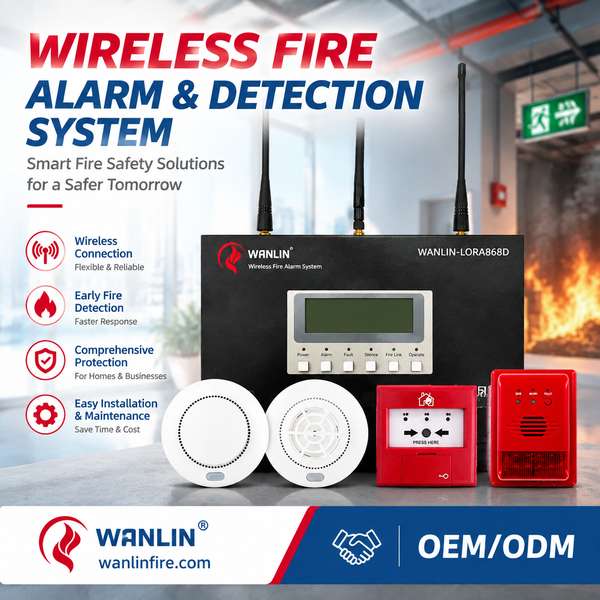
What a buyer in the Czech Republic should expect from a wireless fire alarm manufacturer in China:
- Reference route: temporary wireless fire alarm configuration built to the standard named for the destination market, with the layout review interval written into the order
- Radio scope: LoRaWAN between the field devices and the gateway, with 4G, Wi-Fi or fixed network backhaul from the gateway, and the frequency plan stated for the destination
- Documentation scope: certificate numbers, a technical file per destination, radio compliance evidence per configuration and labelling in the language the market expects
- Commercial scope: FOB, CIF or EXW terms, a sample order before bulk, and consolidation with the rest of your fire product order in one shipment
Case Study: Prague Campus Estates Manager Sourcing Success
A heritage interior in Prague needed detection and could not be chased for cable, which removed most of the market.
The building had grown by accretion for thirty years and the detection had grown with it, one floor at a time, by whoever was cheapest that year.
What settled it was a commissioning sheet with every device recorded against a location. Stefan Meyer signed off the first Wireless Fire Alarm System for Site Offices order covering 10 sites in the Czech Republic, and the specification was rebuilt around the hazard list and the commissioning record rather than around a brand name.
The technical file was reviewed by the local consultant over 29 days, and the questions came back in writing. The first drill after handover found two devices on the wrong grouping and one that had been offline since the previous quarter.
Problem Analysis & Field Report: Why Buyers in the Czech Republic Need Wireless Fire Alarm System for Site Offices
The device that is not supervised is the device nobody knows is missing, and a fire system is only as good as its offline list.
A site office in Prague opened three months before the fixed line arrived.
Field case: An inspection in Prague asked what the means of raising the alarm is on the current phase and the site pointed at the plan from the start of the job.
-
Below ground works with no coverage at all
Devices with no record of which site they are on
No fixed line and no cellular backhaul plan
Alarm audible on site but not reaching people wearing hearing protection
Why Wireless Fire Alarm Is Specified Where Wiring Is Not Practical, and How the Signal Reaches the Console
A wired fire alarm system is still the right answer for a new building with a clear containment route and a programme that allows a first fix. It stops being the right answer when the building is occupied, the fabric is protected, the containment is full or the layout is going to change before the paint is dry. In those four cases the cable is not the product, it is the constraint, and the constraint usually costs more than the detection.
The trade is real and it should be stated plainly. A radio device needs a cell, a cell needs replacing, and the network needs a path. What offsets that is supervision: a supervised radio device tells you it has gone quiet, while a wired device that has been disconnected during someone else work simply stops being there. A fire system is only as good as its offline list, and a wireless system that reports its own health gives you that list for free.
The path itself is short and worth understanding before you buy anything. A detector or a call point sees smoke, heat or a hand on the device, and sends a small message over LoRaWAN to the gateway on its level. The gateway holds the radio side and puts the message onto the backhaul, which is cellular, Wi-Fi or the site network depending on what the site has. The platform receives it, matches it to the device identity and the recorded location, and drives the alarm units and the message group. Three links, and each one has an owner.
The part buyers get wrong is the first link. The device to gateway path is decided by what is between them, and the survey is what tells you what that is. A gateway per level in a basement, a gateway on the far side of a lift core, an antenna extension at one position instead of eleven: these are survey outputs, and a quotation produced before the survey is a guess with a price on it.
What a Wireless Fire Alarm Tender Actually Asks For: Clause by Clause
Tender documents for wireless fire alarm systems have become detailed enough that the hardware is the easy half. The clauses below are the ones that decide who can bid and who cannot, and they are worth reading before you write your own specification or answer someone else, because each one has a cost attached that most quotations hide.
Console and access. A web based application reachable from desktop and mobile, with permission levels, multi terminal login and a stated number of concurrent users. The clause often asks for the application to transfer to the client at the end of the service term, which turns a product purchase into a handover obligation.
Group behaviour. When a call point is operated or a detector passes its threshold, the alarm units operate together. Tenders increasingly name the timing: all units operating within one minute of the trigger unless a person intervenes, which is a design statement about the network rather than a device feature.
Messaging. A message path to a named group of people, with an annual allowance and a per message rate beyond it, and an escalation rule when an alarm has been sounding unattended for a stated number of minutes. The allowance, the group size and the escalation interval are all priced lines, and they are the lines that run out first.
Gateways and backhaul. A stated number of gateways per level, each with internet access over cellular or Wi-Fi, with the network service carried for the contract term. The clause usually adds that the radio technology must comply with the national frequency rules, which makes the frequency plan a legal matter rather than a configuration detail.
Power. Mains powered alarm units and gateways with a standby duration named in hours, automatic restart and recharge after a supply failure, and battery powered detectors and call points with a minimum cell life named in years. The standby duration and the cell life are the two figures most often quoted without the conditions that produce them.
Environments. An ingress rating across the components, commonly IP67 on the gateway, the alarm unit and the call point, plus an antenna extension priced as a variation for positions where the survey shows a weak path.
Identity and marking. An identification number and a label on every device, and a back plate behind each call point carrying the operating instruction in the languages the site uses. This is the clause that decides whether the console reads as a location or as a serial number.
Console modes. A test mode that silences the alarms and keeps the console live, an investigation mode that delays the wider alarm by a fixed number of minutes with a rule for cancelling it, a normal mode, and an evacuation mode that operates everything and messages every group at once. The delay rule matters more than the delay feature.
Server and hosting. A platform sized for a stated number of devices and concurrent users, with backups at a stated interval, and either a physical server with its own standby power or a private cloud with the subscription prepaid for the contract term.
Service and warranty. A named support team, response times in hours for the application and for the hardware separately, a quarterly inspection of the hardware, a quarterly test drill, and a hardware warranty of at least two years excluding third party physical damage.
Pricing structure. Each component priced separately and priced per location, because the quantities differ by floor, by phase and by building. Variations are priced per unit: the antenna extension, the extra person on the message group, the extra message beyond the allowance.
Figures written into live documents. To give the clauses a scale rather than a description, these are numbers that appeared in a high rise commercial tender we answered for a joint venture developer: alarm units rated at 100 dB at three metres, two hours of standby power behind the gateway and the mains powered alarm units, a minimum three year cell life on the battery powered detectors and call points, a platform sized for one thousand devices and fifty concurrent users, push messages to a named group through a common messaging application with an annual allowance and a rate beyond it, a stated window of ten minutes for the platform to apply an upgrade without taking the system out of service, quarterly hardware inspection, a quarterly test drill, and a hardware warranty of three years excluding third party physical damage. Buyers searching for a supplier usually start from numbers of exactly this kind, so it is worth knowing which of them your own market writes down and which it leaves to the bidder.
Every number in the list above is a requirement a buyer wrote, not a value on our datasheet. We quote against the clause you actually have, and where our configuration meets a line we say so in writing and where it does not we say that instead. That is the difference between a tender response and a catalogue.
Radio Coverage, Gateway Placement and the Basement Problem in the Czech Republic
Coverage is the part of a wireless fire alarm that fails quietly, and it fails in the same way on almost every project: the gateway count came from a floor area before anybody walked the building. A reinforced slab is the single most effective thing a building does to stop a radio signal, and a lift core, a plant room and a steel shutter each do their own version of the same thing.
The method that works is unglamorous. Take the drawings and the construction, walk the building, place a gateway, measure, and move it until the path is real. Record what you did. That record is the commissioning sheet, and it is the document that decides whether the coverage you designed is the coverage you still have after the first layout change.
Below ground is where this matters most. A basement level often has no path up at all, and the answer is usually a gateway on the level rather than an antenna fight with the slab. Car parks add their own problems: vehicle exhausts and dust argue for heat heads in the parking area, plant noise argues for an alarm unit count taken from a sound level check rather than from a room count, and the ramp between levels is routinely missed because it sits between the surveys.
The antenna question comes up on every project and it is worth being blunt about it. An extension is a fix for one position with a known problem, not a substitute for a gateway that should be somewhere else. We price it as a variation, per unit, because that is how tenders ask for it and because using it as a default means paying for it eleven times instead of placing one gateway.
Power Budget, Console Behaviour and Escalation When Nobody Responds
Power is two separate decisions in one system. The mains positions, which are the gateways, the alarm units and the panel, need a standby duration named in hours and a behaviour after a supply failure: restart, recharge, and report. The battery positions, which are the detectors and the call points, need a cell life stated in years and a low battery report that arrives early enough to plan a visit rather than discover a silence.
Both figures depend on conditions, and quoting either without them is how suppliers get caught. Cell life moves with the reporting interval, with temperature and with how much traffic the device carries. Standby duration moves with the load and with the age of the cell. We state both per model datasheet with the conditions attached, and we put battery level on the console per device, because a column on a list is a maintenance plan while a device going quiet is an event.
Console behaviour is where the operational value sits. A test mode that keeps the console live while the alarms are silent lets a site run a drill without evacuating it. An investigation mode with a fixed delay and a written rule for cancelling it lets somebody walk to the room before the building is cleared, and the cancellation rule is the part that stops a delay becoming an outage. An evacuation mode operates everything and messages every group at once.
Escalation is the clause that covers the worst case, which is an alarm sounding while nobody is standing at a panel. A rule that messages a second group when the alarm has been running unattended for a stated number of minutes is cheap to configure and the only thing that helps at three in the morning. We set the interval at commissioning, name the group, and record both.
Product Introduction: Wireless Fire Alarm System for Site Offices by Wanlin Fire
The configuration below is what goes into a submittal pack: devices, gateways, console and the documents that come with them. When the escape route, the hot work and the plant all move, the WANLIN-868D moves with them instead of describing a site that no longer exists.
The range covers wireless fire alarm system, wireless fire alarm control panel, wireless smoke detector, wireless heat detector, wireless manual call point, wireless sounder and beacon, wireless fire alarm gateway, LoRaWAN fire alarm, battery powered wireless fire alarm, wireless interconnected smoke alarm, cloud monitored wireless fire alarm, remote monitored wireless fire alarm, wireless fire alarm retrofit, temporary wireless fire alarm for construction sites, wireless fire alarm for warehouse buildings, wireless fire alarm for basement car parks, wireless fire alarm for heritage buildings and wireless fire alarm for high-rise buildings, and we quote against whichever of those your market actually searches for rather than against a single catalogue name.
Network options cover LoRaWAN wireless fire alarm, LoRaWAN gateway based fire alarm network, private LoRaWAN fire alarm network, RF wireless fire alarm, WiFi wireless fire alarm, Zigbee wireless fire alarm, Z-Wave wireless fire alarm, Bluetooth wireless fire alarm, 4G wireless fire alarm, 4G LTE wireless fire alarm, NB-IoT wireless fire alarm, IoT wireless fire alarm, cloud connected wireless fire alarm, remote monitoring wireless fire alarm, addressable wireless fire alarm, conventional wireless fire alarm, networked wireless fire alarm, interconnected wireless fire alarm and standalone wireless fire alarm, and the choice between them depends on the structure and on what the site has for backhaul.
Device options cover wireless smoke detector, wireless heat detector, wireless smoke and heat detector, wireless multi-sensor detector, wireless manual call point, wireless fire alarm sounder, wireless fire alarm strobe, wireless alarm unit with two hour standby, wireless sounder strobe network, wireless call point network with location identity, wireless fire alarm control panel, wireless fire panel with web console and wireless fire alarm gateway. Every one of those is a position on a point list rather than a product to be chosen from a photograph.
| Specification | Detail |
|---|---|
| System reference | WANLIN-868D Construction Site Wireless Fire Alarm System |
| Product category | Temporary wireless fire alarm coverage that moves with the build, for sites where the escape route and the risk change every month |
| Radio network | LoRaWAN radio to the gateways with cellular backhaul, since a site under construction rarely has a fixed line |
| Detection and trigger | Manual call points and detection at the positions the current phase needs, with hot work and plant areas covered |
| Supervision and health check | Every device reports battery level, signal strength and offline conditions separately from the alarm |
| Protocol and integration | Gateway to platform over MQTT or HTTPS, with the console reachable from the site office and the phone |
| Notification path | Alarm units on the network plus a message path to the site duty group depending on configuration |
| Alarm behaviour | Alarm latching until reset at the panel, with the beacon continuing after the sounder is silenced |
| Power supply | Long life primary cells at the device positions, mains with standby where the site supply is established |
| Housing and mounting | Ingress rating per model datasheet, with the devices expected to be moved and refixed rather than installed once |
| Installation pattern | Layout reviewed at each phase change, with the register updated on the same visit |
| Environmental rating | Ingress rating stated per model datasheet, with IP67 built on the gateway, alarm unit and call point positions where the configuration is specified for them |
| Coverage planning | Gateway count and placement taken from a radio survey rather than from the floor area, with the result recorded on the commissioning sheet |
| Maintenance and testing | Automatic self-check with fault, low battery and offline conditions reported separately, test interval set by the site operator and recorded on the drill record |
| Export documentation support | Technical file prepared to support local code submittals and national registration by the importer of record, including radio compliance evidence per destination |
| Certification documents | CE, RoHS and REACH documentation per applicable model, with EN 54-25 route papers on the wireless configurations and EN 54-7 or EN 54-5 papers on the detector heads, certificate number provided on request |
| OEM and ODM options | Logo, part number, packaging, manual languages, label artwork and platform identity string configurable |
| Full datasheet | Complete radio, electrical, battery and environmental data provided per model on request |
| Warranty | 24-month |
Application Scenarios for Wireless Fire Detection in the Czech Republic
| Scenario | Model | Why it fits |
|---|---|---|
| Multi storey build where the escape route changes with the structure | WANLIN-222 | The call point moves with the route instead of staying where the route used to be |
| Hot work area that changes position week by week | WANLIN-340 | Detection follows the work rather than the drawing that was current at the start |
| Site office and welfare block brought on early | WANLIN-307 | The occupied part of the site is covered from the day it is occupied |
| Basement excavation with plant running below ground | WANLIN-868D | A gateway at the level keeps the devices below ground on the network instead of relying on a path up the ramp |
Certification, Standards and National Registration Support for the Czech Republic
The comparison that matters in this category is not the datasheet against the datasheet, it is whether the supplier can produce the same file twice. The wireless part of a fire system carries a second compliance layer that the wired part does not: the radio has to be legal in the country it operates in, and the same hardware at the same power is not legal everywhere.
- Reference route: temporary wireless fire alarm configuration built to the standard named for the destination market, with the layout review interval written into the order
- Environmental rating stated per model datasheet so the submittal matches the device delivered
- Certificate number provided on request, with the issuing body named so you can verify it
Standards and paperwork buyers ask for include EN 54-25 wireless fire alarm, EN 54-2 control and indicating equipment, EN 54-4 power supply equipment, EN 54-7 smoke detector, EN 54-5 heat detector, EN 54-11 manual call point, EN 54-3 sounder, CE certified wireless fire alarm, CE marked wireless fire alarm, RoHS compliant wireless fire alarm, REACH compliant wireless fire alarm, FCC certified wireless fire alarm, FCC Part 15 wireless fire alarm, UKCA marked wireless fire alarm, UL listed fire alarm, ETL listed fire alarm, CSA certified fire alarm, VdS approved fire alarm, LPCB approved fire alarm, FM approved fire alarm, NFPA 72 fire alarm, BS 5839 fire alarm, ISO 7240 fire alarm, ISO 9001 fire alarm manufacturer, ISO 14001 fire alarm manufacturer, EAC certified fire alarm, GOST certified fire alarm, CCCF certified fire alarm, TISI certified fire alarm, SNI certified fire alarm, SIRIM certified fire alarm, PS Mark fire alarm, DTI-BPS certified fire alarm, BFP approved fire alarm, BIS certified fire alarm, SASO certified fire alarm, SABER certified fire alarm, Civil Defense approved fire alarm, SBC 801 compliant fire alarm, NIST traceable calibration, type approved fire alarm, third-party certified fire alarm, laboratory tested fire alarm, certificate of conformity, declaration of performance and CE declaration.
Local approval for a fire installation is issued to the licensed contractor or to the importer of record, not to the factory. Our role is to supply the file those parties submit: local code submittal support with per-configuration technical files, radio compliance evidence for the destination and national registration support for the importer of record. Certificate numbers are provided on request, and we recommend you verify the issuing body reference yourself, because that protects your client as much as it protects us.
| Document | What it covers |
|---|---|
| Technical file per destination | Submittal pack for the authority having jurisdiction, matched to the ordered model rather than to the range |
| Radio compliance evidence | Frequency plan and configuration stated for the destination, since the same hardware is not legal at the same power everywhere |
| Standard route | temporary wireless fire alarm configuration built to the standard named for the destination market, with the layout review interval written into the order |
| Certificate numbers | Provided on request with the issuing body named so the reference can be checked |
| Commissioning record | Every device recorded against a location, with the gateway placement and the grouping as commissioned |
| Drill and test template | A record the site can produce at an inspection rather than reconstruct from memory |
Why Choose Wanlin Fire as Your Wireless Fire Alarm Manufacturer for the Czech Republic
A wireless programme is a survey, a configuration, a submittal file and then a shipment, in that order. Partners across North America, Europe, Asia-Pacific, the Middle East, Africa and Latin America run this model today.
- Production capacity stated per configuration with the lead time written into the order
- Radio configuration set for the destination frequency plan and recorded on the order
- Written gateway counts from a survey rather than from a coverage radius
- A commissioning sheet with every device recorded against a location
- Battery level visible per device, so replacement is a list and not a surprise
- Hosting quoted separately from hardware so the end of term handover is clean
- Sample order before bulk, with the bulk built on the same line and the same configuration
| Decision factor | What we put in writing |
|---|---|
| Coverage | Gateway count and placement from a radio survey, recorded on the commissioning sheet |
| Supervision | Battery level, signal strength, fault and offline states reported separately from the alarm |
| Power | Standby duration and cell life stated per model datasheet with the conditions that produce them |
| Backhaul | Cellular, Wi-Fi or fixed network named in the order, with the owner of the connection named too |
| Console | Test, investigation, normal and evacuation behaviour set at commissioning and recorded |
| Documents | Technical file per destination, radio compliance evidence and certificate numbers on request |
| Commercial | FOB, CIF or EXW, MOQ stated per configuration, and variations priced per unit |
Wireless Fire Alarm OEM and ODM Programmes for Distributors in the Czech Republic
Distributors and trading partners in the Czech Republic usually arrive with a tender in front of them rather than a product idea, which is why the programme below is built around the documents rather than around the box.
- Housing, brand and artwork: Replacement cycle and consumables quoted as a line so your margin is visible
- Register and identity: Platform identity string configurable so the console carries your name rather than ours
- Documentation: Neutral housing with no factory branding as the default for distributor programmes
- Manuals and languages: Order tracking and documentation pack delivered in one file per shipment
- Packaging and channel: Consolidated shipments across your product lines from one factory
- After sales and replacement cycle: Private label and white label programmes available from the first order size
Wholesale and distribution programmes run on the same three things a tender does: certification support for the destination, after-sales documentation written for your own service team, and spare parts held under your part number so a replacement is a swap rather than a commissioning visit. Every distributor, trading company and importer gets the same technical file, and the file is addressed to your company so your client sees your name on the submittal rather than ours.
Minimum order quantity is stated per configuration and depends on whether the order carries your artwork or ours. A private label programme on an existing configuration starts lower than a dedicated run with your own enclosure colour, and we say which is which on the quotation rather than quoting one number for both. Spare devices and replacement cells are supplied under your part number, so your service team holds stock that matches the register it maintains.
Customer Testimonials
Three partners on what changed after they moved to a supervised wireless network:
- Andi Kurniawan (Hospital Estates Manager, Bucharest, Romania): "The drill template arrived with the order and the authority accepted it as it stood in Romania."
- Luis Ortega (Facilities Manager, Bogota, Colombia): "Battery replacement is a column on a list now instead of a surprise, and that is what changed our maintenance cost in Bogota."
- Stefan Meyer (Campus Estates Manager, Prague, the Czech Republic): "The hosting line being separate from the hardware is what made the handover clean at the end of the term in the Czech Republic."
Frequently Asked Questions
Q: Is a fire alarm required on a construction site?
A: Most markets require some means of raising the alarm, and many require it to change as the build progresses. The requirement is local and it is enforced locally, so we supply the documentation for the submittal and we do not tell a client what their authority will accept.
Q: How often does the layout need reviewing?
A: At each phase change, and in practice that means the review is a standing item rather than an event. The escape route moves, the hot work moves and the plant moves, and a network laid out at the start of the job describes a site that no longer exists by the middle of it.
Q: What happens to the devices when the job finishes?
A: They come off the register and move to the next site, which is the commercial reason contractors buy rather than rent. The register is cleared and rebuilt per job, and the event history for the finished job is exported and archived.
Q: Does the system work without site power?
A: Yes for the device positions, which run on their own cells, and the gateway and alarm units use the site supply with standby where it exists. Cellular backhaul covers the site before a fixed line is in place, and the data plan is a commercial line item with its own term.
Q: Can the alarm reach people who are not near a sounder?
A: The message path to the duty group covers that, and it is the part of a temporary system that matters most because the site population is spread out and often wearing hearing protection. We configure the group and record who is on it.
Project Summary
Net result: By working directly with manufacturer Wanlin Fire, Prague Campus Estates Manager Stefan Meyer gained 35% margin headroom through factory direct sourcing, a written gateway count, per-configuration documentation and a commissioning sheet the site can produce after an event. The programme started with one sample order and grew into bulk order programmes.
For more information: www.wanlinfire.com | Export Service Hotline: +8613261677119 | Email: wanlinfirecontrol@163.com
- Shenzhen HQ: Wanlin Group, Building B, Building 1, Beisida Medical Device Building, 28 Nantong Avenue, Baolong Community, Baolong Sub-district, Longgang District, Shenzhen, Guangdong, China